


Pricing & Margin Confidence for Lowest-Bid Public Work
Quick read


Won.
Lost.
Won… but left money on the table.
On lowest-bid work, that third outcome is more common than people admit. It’s also one of the easiest profit leaks to fix – if you can see it.
If you win within 1-5% of the runner-up, you were competitive and you probably didn’t donate the farm.
But when you win by 20%, 30%, or more, it’s different.
Same scope.
Same schedule.
Same risk.
Less revenue than the market would have supported.
That’s not “being safe.” That’s giving margin away.
You don’t need a complicated model. Start with a consistent method.
For each win, record:
A simple approximation:
Max-win ceiling = runner-up bid – $1
Money left on the table = (runner-up bid – $1) – your bid
Is it perfect? No.
Is it directionally correct? Yes.
And it forces the right question: why were we that low?
That’s not “being safe.” That’s giving margin away.
On unit-price jobs, the gap is rarely “everything.” It’s usually concentrated in a few items:
If you identify the items that drove the spread, you can fix it next time without cutting your whole bid.
These numbers add up fast. And the conditions that cause them aren’t going away.
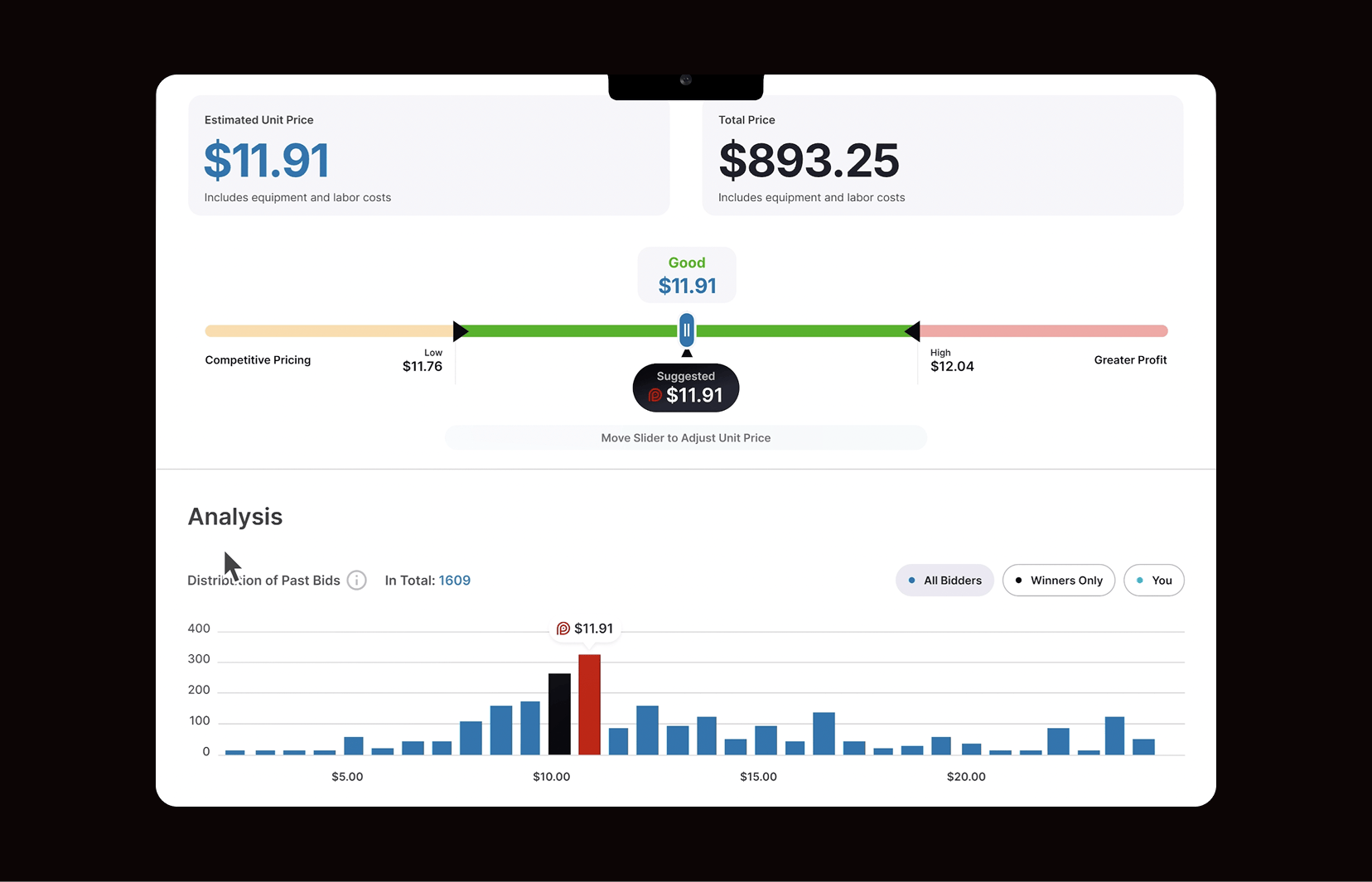
PinPoint shows you where your line estimate sits — grounded in actual bid data and AI analysis.
Bid behavior has gotten more volatile:
If you only have internal costs and gut feel, you’re always learning after the fact.
“Winning by a penny” is a mindset:
Closer is the profit zone.
This playbook doesn’t add work. It just turns the data you’re already getting on bid day into a system you can actually use.
Use this after every bid opening:
Track:
This turns bidding into a system, not a mood.
COO and co-founder Mark Zurada explains the real cost of underbidding — same work, less margin.
“Winning by a penny” is a mindset
PinPoint is built for the validation step — the moment between your internal estimate and your final number. Bid Intelligence gives you the market range and likely winning number so you know whether to hold or sharpen. Portfolio Analysis surfaces your bid gap patterns over time, so you can see exactly where you’ve been giving margin away.
Stop finding out you won by $300K after bid day. Start knowing where the ceiling is before you submit.

Further Reading
Learn about Bid Intelligence and see how you can predict the winning number before bid day:
https://www.pinpointanalytics.ai/estimating-support-software/bid-intelligence
See how Portfolio Analysis ties insights back to your own results:
https://www.pinpointanalytics.ai/estimating-support-software/portfolio-analysis
See how Historical Bid Search provides access to 10+ years of bid tabs:
https://www.pinpointanalytics.ai/estimating-support-software/historical-bid-search
Get a clear view of where the market lands. Join contractors who price jobs with data, not guesswork.

